2025 Survey Results: International and Conservative Students
Conservative and international students face different challenges: one feels forced to self-censor while the other reports fewer job opportunities. No significant impact on employment is found for either but conservative respondents report higher rates of satisfaction in philosophy.

For the final summer post on the 2025 survey, we highlight two populations of survey participants: those who are or were international students and those with conservative political leanings. We chose these populations for a straightforward reason: both groups show signs of underrepresentation while also seeming to report higher satisfaction in prior surveys. That is, according to an analysis of the 2023 survey results, international students were less likely than local students to find permanent academic employment, while according to an analysis of the 2021 survey results, conservative students are underrepresented in philosophy PhD programs relative to both the U.S. population and doctoral recipients. Yet, in past surveys we have noted that both of these groups appear to report higher satisfaction than local or non-conservative participants (not tested for statistical significance). We thus wanted to better understand the experiences of both populations and the challenges they face in the discipline.
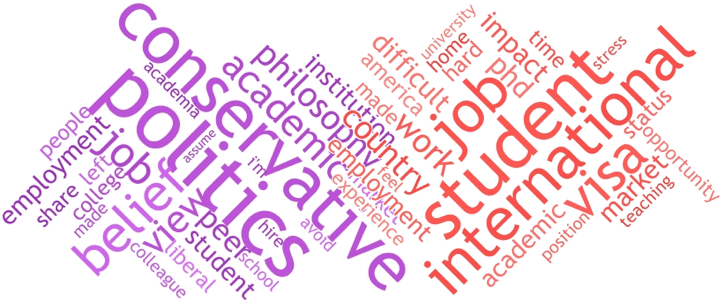
To explore this we added two text-based questions to the 2025 survey with a parallel structure. These questions appeared on the final, demographic page of the survey for a subset of participants. The first followed a question on international status: "Are you or were you an international student during your PhD studies?" If the participant answered "yes" (n=383) then they were provided a follow-up prompt: "Please describe the impact of your status as an international student on your academic career (i.e. as a student and in employment or the search for employment, if relevant)." The second followed a question on political leaning: "When it comes to politics, how do you usually think of yourself?" If the participant answered "conservative" or "very conservative" (n=58) they were provided a follow-up prompt: "Please describe the impact of your political beliefs on your academic career (i.e. as a student and in employment or the search for employment, if relevant)." Word clouds with the top 25 mentioned words by each group are provided in the image below.
We provide some insights on the responses to these prompts in this post. But, first, it may be useful to see how these groups differ in response to other questions on the survey. Since international and conservative status overlap for some participants, for statistical analyses we grouped them as follows: conservative participants were grouped together regardless of international status, due to the small size of this group (58 participants, 14 of whom are also international); international students (369 participants, with 150 very liberal, 132 liberal, 68 moderate, and 19 who didn't answer on political leaning) were then distinguished from local students (708 participants, with 325 very liberal, 243 liberal, 105 moderate, and 35 who didn't answer on political leaning); and left out were all those who were not conservative and did not provide their international status (73 participants). (Note that "students" is used here as shorthand for all those who currently are or once were international/local students; some are no longer students.)
Several questions measure satisfaction of some sort, whether with one's PhD program overall, the climate of that program, one's employment (if a recent graduate), or one's financial situation (if a current graduate student). Conservative participants tend to provide higher ratings in general: if we combine the answers to these four questions the mean is 4.3 for conservative participants vs. 4.0 for both international and local students (p<.005). (The individual ratings are 4.3 vs. 4.2 for PhD program, 4.6 vs. 4.0 for climate, 4.3 vs. 4.1 for employment satisfaction, and 3.3 vs. 3.3 for financial satisfaction.) International students appear to provide higher program ratings than local students (4.2 vs. 4.1), but the difference is not statistically significant and they respond similarly to local students on the other satisfaction questions (both 4.0 on climate, both 4.1 on employment satisfaction, 3.3 vs. 3.4 on financial satisfaction).
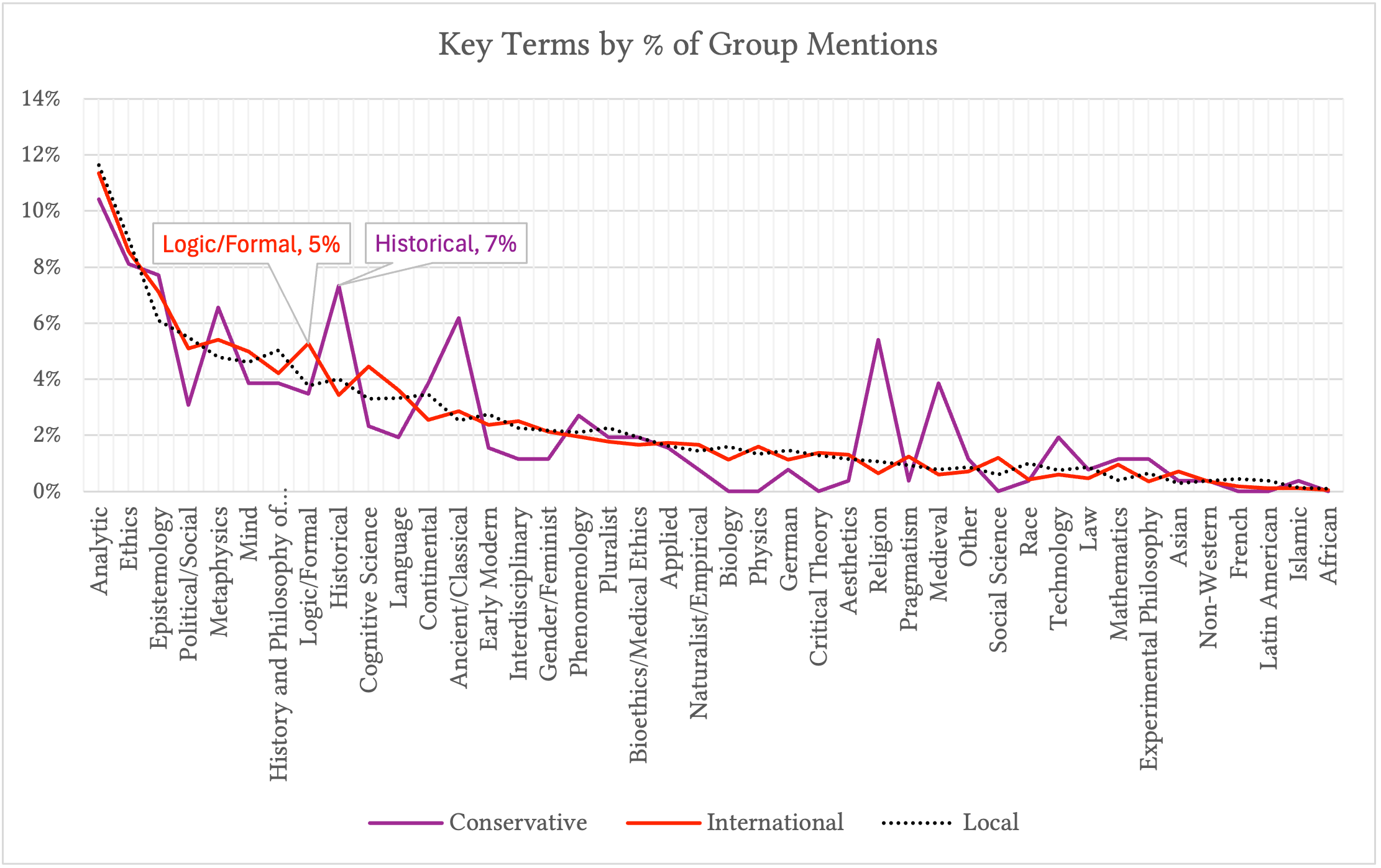
In terms of key terms used to describe PhD programs, differences also emerge. If we look, for example, at the most mentioned key terms in each group, all three groups have Analytic, Ethics, and Epistemology as their top three terms but start to diverge after that (see the chart below). For instance, while only conservative participants have Ancient/Classical, Religion, and Medieval in their top 10 terms; only international students have Cognitive Science and Language. Both conservative participants and local students (but not international students) have Historical and Continental, while both international and local students (but not conservative participants) have Logic/Formal and Political/Social. (The other top 10 terms shared by all three groups are Metaphysics, Mind, and History & Philosophy of Science). The chart below shows all the key terms with the percentage of mentions for those terms by each group.
While the mean graduation years are about the same for these groups (2020 for conservative participants and international students, but 2019 for local students), international students include more current students: 48% of all participants, versus 34% for both conservative participants and local students.
Finally, financial status and employment outcomes appear to differ between these groups, but only one difference is statistically significant. Namely, reported graduate student income is lower for conservative participants (mean=$26k) than for international (mean=$35k) or local students (mean=$36k; p<.005). Other trends are not statistically significant, which could be due to small numbers or a reflection of mere "noise"/variation. Namely, conservative participants also appear more likely to prefer academic jobs (88%, versus 84% for both of the other two groups) but less likely to be in academic jobs (77% of conservative participants who are employed are in academic jobs vs. 85% of international students and 84% of local students). The median salary 0f conservative participants is slightly higher than other groups at $82k vs. $75k/$78k, while the mean salary is slightly lower at $89k vs. $97k/$95k.
International students, on the other hand, appear at first glance to be slightly less likely to have permanent academic jobs: 67% of international students now in academic jobs have permanent ones, versus 70% of local students and 73% of conservative participants. This difference was not statistically significant using chi-squared, while in 2023 the difference was significant using a regression equation. Since we noted that the top programs for international students were themselves more international (in our survey, only 16% of local students are from non-U.S. PhD programs, whereas 43% of international students are from non-U.S. PhD programs), we decided to check the numbers for two different subsets of this group: those in U.S. PhD programs versus those in non-U.S. PhD programs. We checked this because U.S. PhD programs tend to have higher permanent academic placement rates than non-U.S. programs according to past analyses. In fact, this difference does seem to be responsible for the effect. That is, for those with academic jobs who come from PhD programs in the U.S., the proportion with a permanent position is 72% for international students and 73% for local students. In contrast, for those with academic jobs who come from PhD programs outside the U.S., the proportion with a permanent position is 61% for international students and 53% for local students. As international students have about the same or higher rates of permanent academic employment within these subsets, it must be the difference between the subsets that is driving the effect.
Turning, now, to the text-based responses, clear differences emerge between respondents who report conservative leanings and those who report being or having been international students (for this portion of the blog post these groups partly overlap, with 8 participants providing responses to both questions). Namely, while both groups largely report a negative impact of their status on their academic career, the nature of that impact is quite different, with one group's primary concern that of having to hide their status while the other group's primary concern is that of losing out on employment opportunities.
To determine this we first read through all comments and then came up with a list of common themes: no or minimal impact, negative feelings/emotions, negative behavioral impact, negative social impact, reduced employment opportunities, signs of abuse or trauma, and positive impact. We then hand coded all the comments according to these 7 themes, with some comments containing multiple themes. In a forthcoming paper on a related dataset we found that hand coding sometimes captures negative sentiment that is not picked up through automated techniques; alternatively, one might argue that hand coding can be negatively biased on such topics. We thus used a freely-available automated method as a sanity check. Using the demo version of LIWC-22 on a sample of the (non-private) responses, "negative tone" of both samples was higher than normal, while "positive tone" was lower (see screenshots at the end of the blog post).
Below we provide a breakdown of our hand coding results for both groups along with some sample comments from participants (note that ellipses are sometimes used to replace irrelevant text).
Those with conservative leanings mostly report self-censuring behavioral changes (31% of the 39 posts include this sort of comment); but also concerns about lost jobs or positions (26%); concerns about social standing, such as being ostracized (23%); and feelings of fear or anxiety (13%). A robust proportion saw little to no impact of their political leanings on their academic career (21%). A relatively small number reported abuse or trauma, such as promotion denial or bullying (5%), while another relatively small number reported positive effects (10%). An example of each is provided below:
- no impact: "None"
- feelings: "...As a professor, I have been made uncomfortable at some point at every single conference I have ever attended by casual disparagement of my beliefs, either in general or with reference to me in particular..."
- behavioral changes: "To avoid any (potential) trouble in obtaining a permanent position, I consciously kept my (moderate to right-leaning) political beliefs to myself."
- social standing: "...I think my political beliefs often put me in intellectual conflict (and social alienation) with my peers due to my different perspectives and resulting philosophical interests..."
- jobs/positions: "I keep my political views very very quiet. I hear so much explicit antagonism towards conservatives and have no interest in constantly being on the defensive vis a vis my peers. I have also heard too many stories of people being rejected from academic positions because a committee member heard they were conservative and refused to hire them."
- abuse/trauma: "...I often had to silently endure people who think like I do being mocked by my peers and professors..."
- positive effects: "I thought being conservative and Christian would hurt me, but there's a growing niche market for conservative and Christian academics. You just have to know where to find these opportunities."
Those who have or had international student status mostly report limitations on jobs or positions (34% of 203 posts); but also significant behavioral changes (31%) in order to manage financial restrictions, paperwork headaches, language barriers, cultural difficulties, and travel challenges (both academic and to see family/friends); feelings of anxiety and stress (20%); and concerns about social standing (8%), such as discrimination for being foreign. A robust proportion again saw little to no impact of their status on their academic career (21%). About the same number reported abuse or trauma (5%), such as extreme stress from precarity, as positive effects (6%). An example of each is provided below:
- no impact: "none"
- feelings: "The stress of study and work permits— financial, time, and emotional drain—impacted me. I was never denied a permit but it was always a risk..."
- behavioral changes: "As an international student, the initial one or two years of PhD program are often challenging due to the need to adapt to the language and a different course structure, making it difficult to complete required reading and essay assignments..."
- social standing: "Feeling marginalized in the earlier years of the program; more comfortable as time went on."
- jobs/positions: "Probably detrimental. Some positions didn't offer visas so I couldn't be hired at all. At others, my status was a consideration against me (not because of some discrimination, just b/c hiring international for the kinds of positions I'd be considered is bureaucratically more difficult)."
- abuse/trauma: "It was extremely stressful...I had to complete my degree in 3 years instead of the normative 6—hence, others who were going on the job market around the same time as me had twice as much time to, e.g., publish, teach, present at conferences, network, etc"
- positive effects: "The department and university are, in my experience and to my knowledge, very supportive of international students."
In sum, whereas conservative participants report feeling forced to hide their status to avoid discrimination, international students report lost job opportunities due to administrative and other hurdles. A major difference is that while both are concerned about employment outcomes one group manages that concern through self-censoring, while the other is unable to hide their status. As mentioned above, we did not find statistically significant effects of either conservative or international status on employment outcomes. It may nonetheless be the case that these groups have to work harder, or with greater stressors, in order to achieve similar rates of employment to non-conservative or local students.
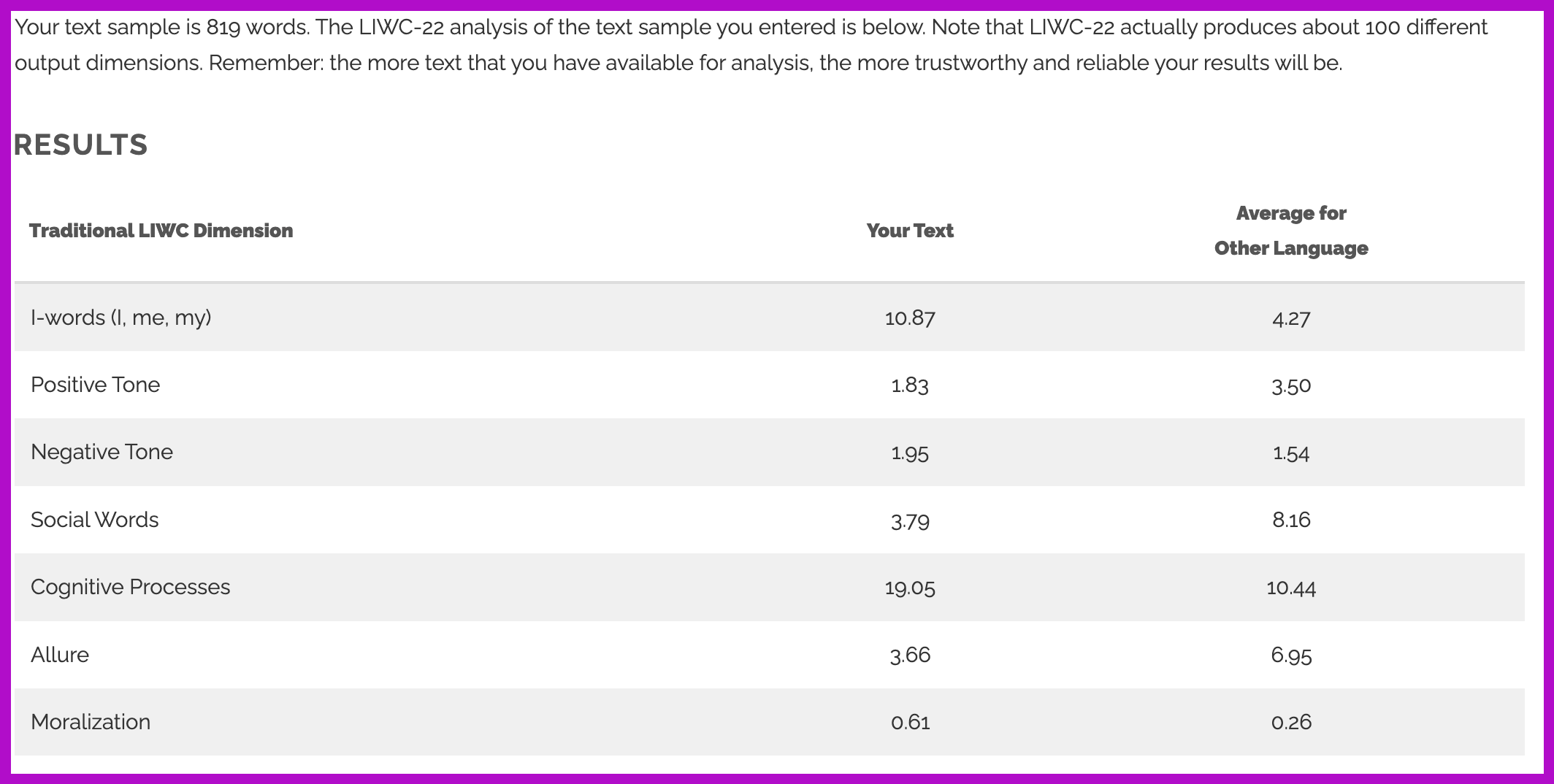
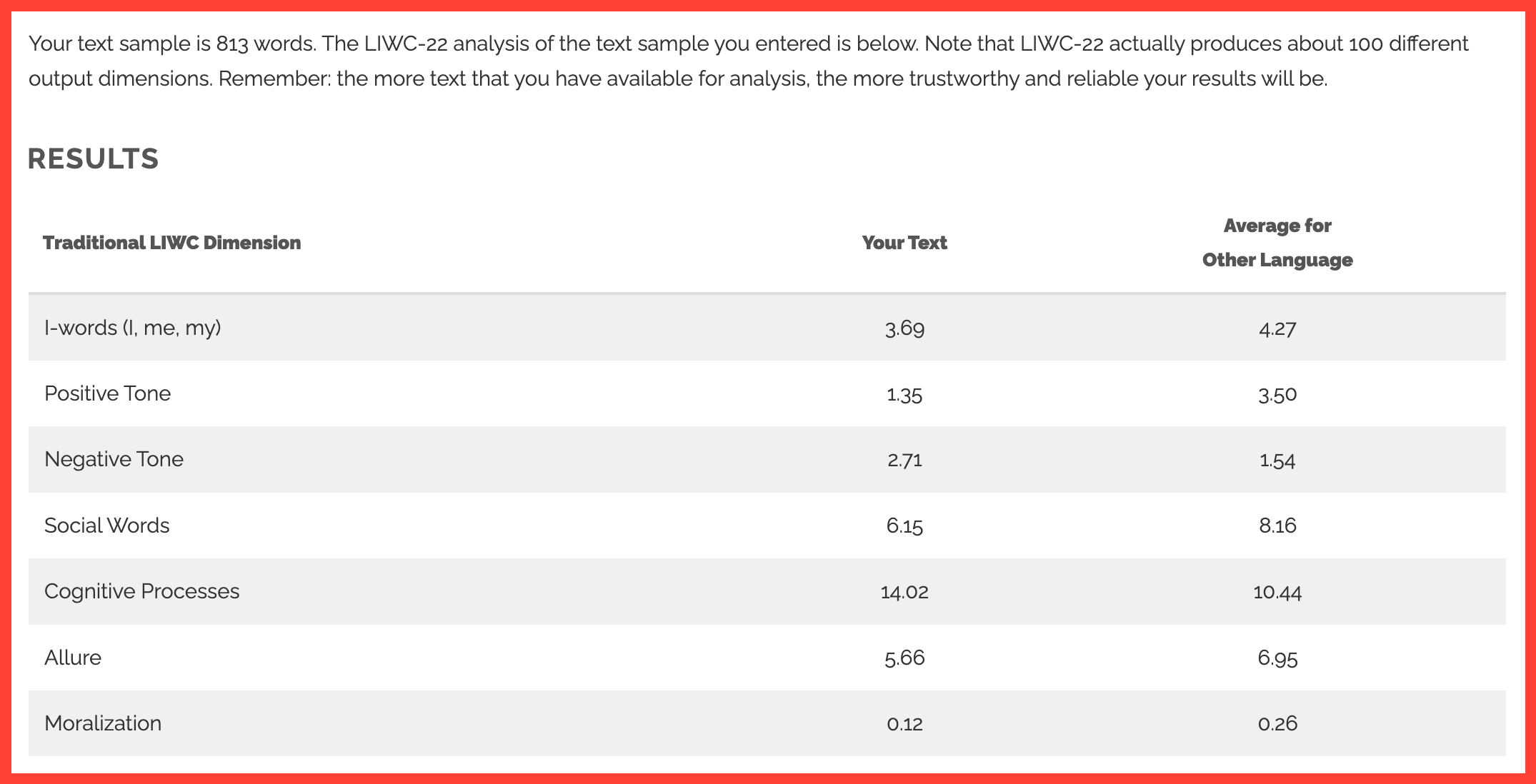
LIWC-22 analysis of randomly selected text-based responses from conservative participants (left) and international students (right) showing lower positive tone and higher negative tone in comparison to "other language."