2026 Data Update on Placement, Program Ratings, Student Comments, and Keywords
Permanent academic placement for philosophy PhDs looks steady, while program and climate ratings are up.

Our last data update was in 2024, covering 2013–2023 graduates and select results from the 2023 survey. This data update includes 2014–2024 graduates and select results from the 2025 survey, which was completed December 31st. More information on the survey, both methodology and results, will be released over the next few months. This post mainly provides information about the data gathering process, placement findings, and comparisons with the last data update. In sum: permanent academic placement looks steady, while program and climate ratings are up. Changes to specific programs' placement rates and program/climate ratings are discussed below.
The first thing to note is the range of included programs. We aim to include all primarily English-language philosophy PhD programs in the world that have available graduation and/or employment data. This year we were able to cover 149 programs, provided in a table below (along with the date that we completed our data checks and a link to the publicly available APDA data). Five of these are new: McMaster University, Universite de Montreal, University of Auckland, University of Bristol, University of Hong Kong, and Uppsala University. There are 65 other programs that we contact but are not yet able to cover due to data availability, which are listed below*. Data checks were a team effort, and we benefitted from the assistance of three undergraduate research assistants: Rocco Perez, Danna Valenzuela, and Devyn Williams. Notes on how we collect the information is available here and on the about page.
The 2024 data update was made available through a Looker dashboard hosted on our website that draws from a Google Sheet. Those who would like to compare the current Looker dashboard with past data can use the old Looker dashboard or that sheet. Note that the data on the Google sheet are organized in a somewhat unorthodox way, with multiple lines per program in most cases (depending on the number of keywords and comments); this has to do with limitations of the Looker software. The most recent data is available on a different Google Sheet, here.
Placement
Initial comparisons on employment show that there is overall consistency across the two years, as well as with prior reports. We reported on 6,407 graduates (2013–2023) in 2024, as compared to 6,314 (2014–2024) now—a slight drop. We counted a graduate as in a permanent academic job if they had any record of such a job in our database, but temporary or nonacademic depending on which was more recent; unknown was used for graduates with no employment record. Numbers were largely consistent across the two time periods: 41% of those in the 2024 update were in permanent academic jobs, compared to 40% now; 38% were in temporary academic jobs, compared to 34% now; 12% were in nonacademic jobs, compared to 17% now; and 10% are unknown for both data sets.
Yet, many have the sense that it is harder for more recent graduates to find permanent academic employment. The Sankey graph below shows a subset of employment outcomes for the most recent graduates (2019–2024) in comparison to older graduates (2014–2019) in this ten-year period, demonstrating a difference in permanent academic placement between more recent and older graduates.
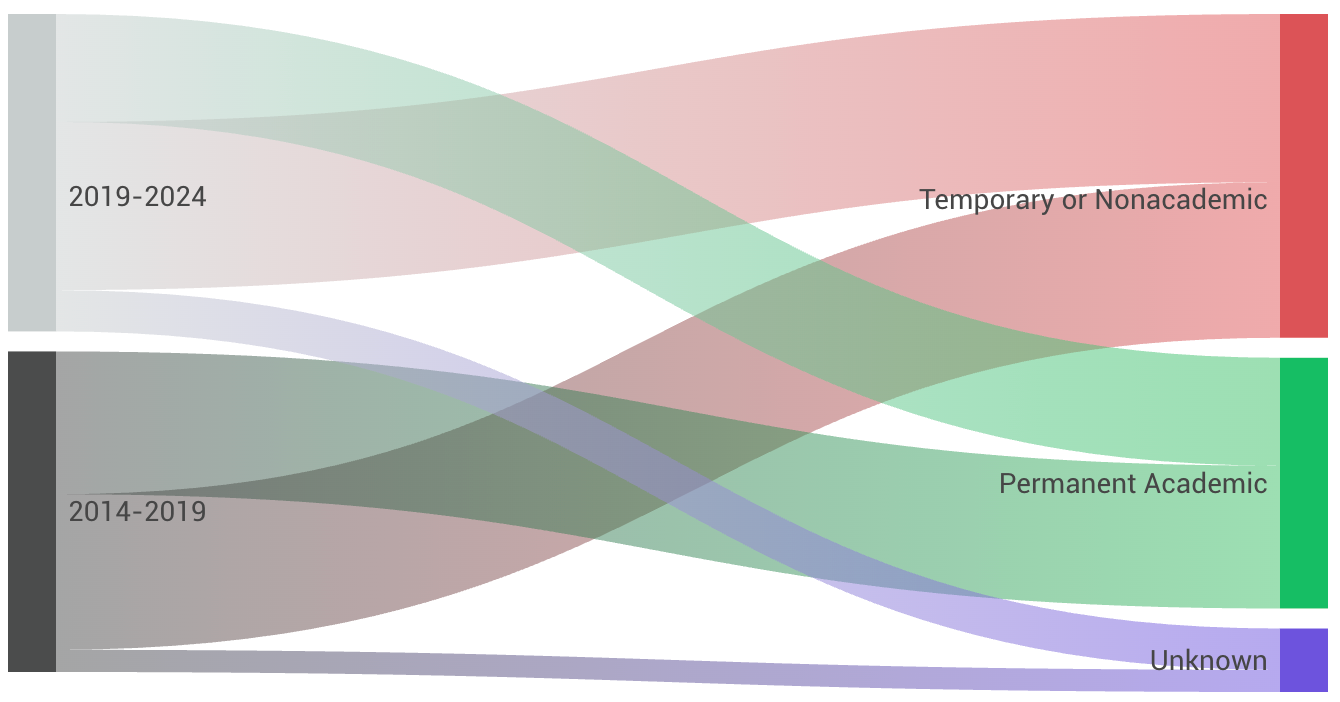
However, despite this apparent difference, more recent graduates do not seem to have a harder time finding permanent academic employment than past graduates, relative to their years out of graduate school. I compared the most recent data with the 2022 APDA report (published in Metaphilosophy), looking at both the graduates of just the past 5 years and the full 10-year span (as reported at the time, in order to compare years out of graduate school for different time periods). While in 2025 34% of the most recent graduates had permanent academic jobs, in 2022 only 30% of the most recent graduates had permanent academic jobs (see the table below).

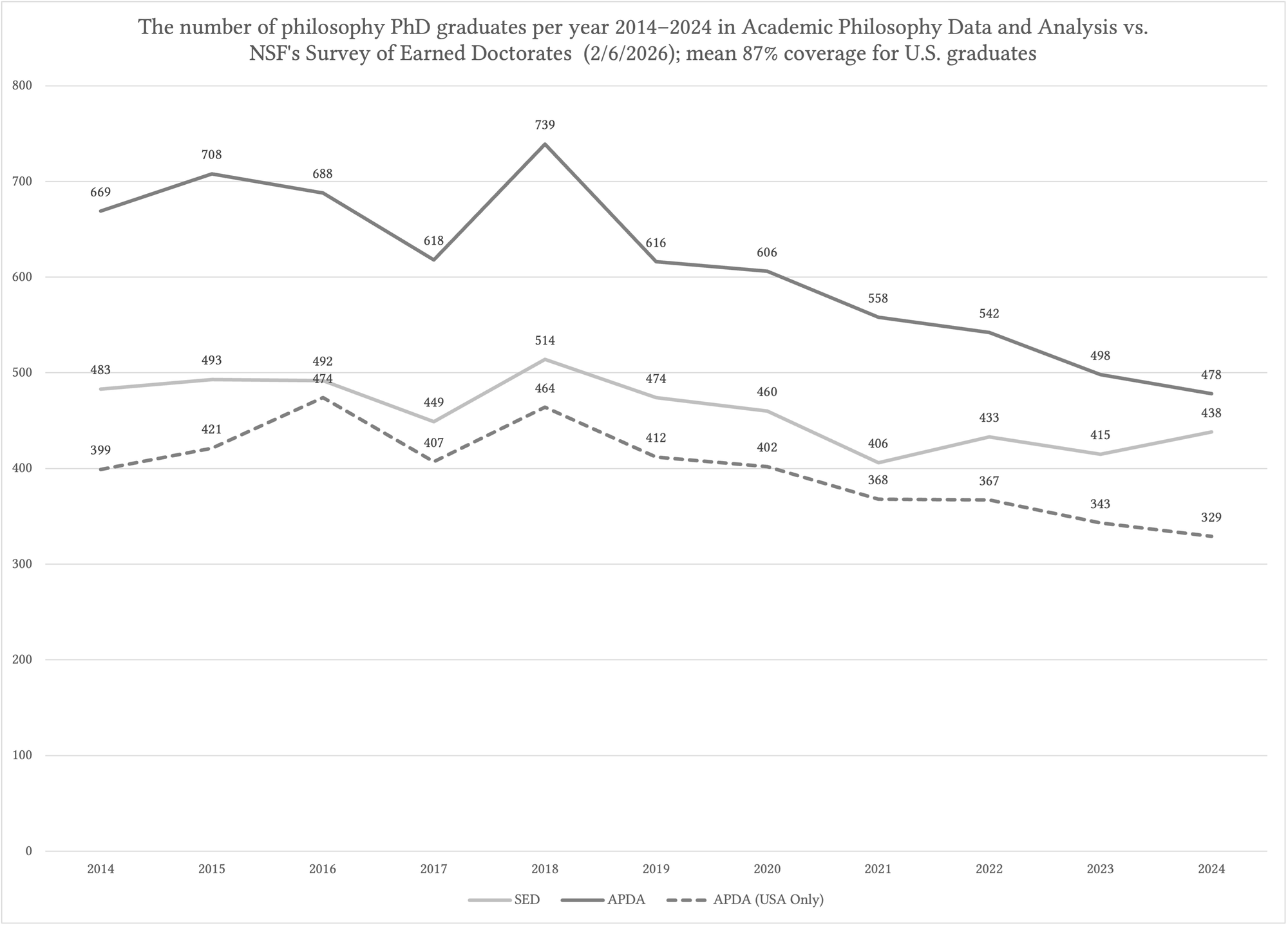
It thus does not look like the most recent graduates are having a harder time finding permanent academic employment, at least in comparison to this earlier group. A caveat is that data gathering has become more challenging in recent years and our database is not as complete for 2024 graduates as it was for earlier years (see the chart below that compares the database numbers to those of the Survey of Earned Doctorates).
I also looked at the nonacademic placement information to see if the uptick in nonacademic jobs in the most recent data is due to those who are not placed in permanent academic jobs; that is, I wondered if older graduates would be more likely to be in nonacademic jobs. As you can see in the table above, there is not much difference between recent and longer term graduates for either dataset.
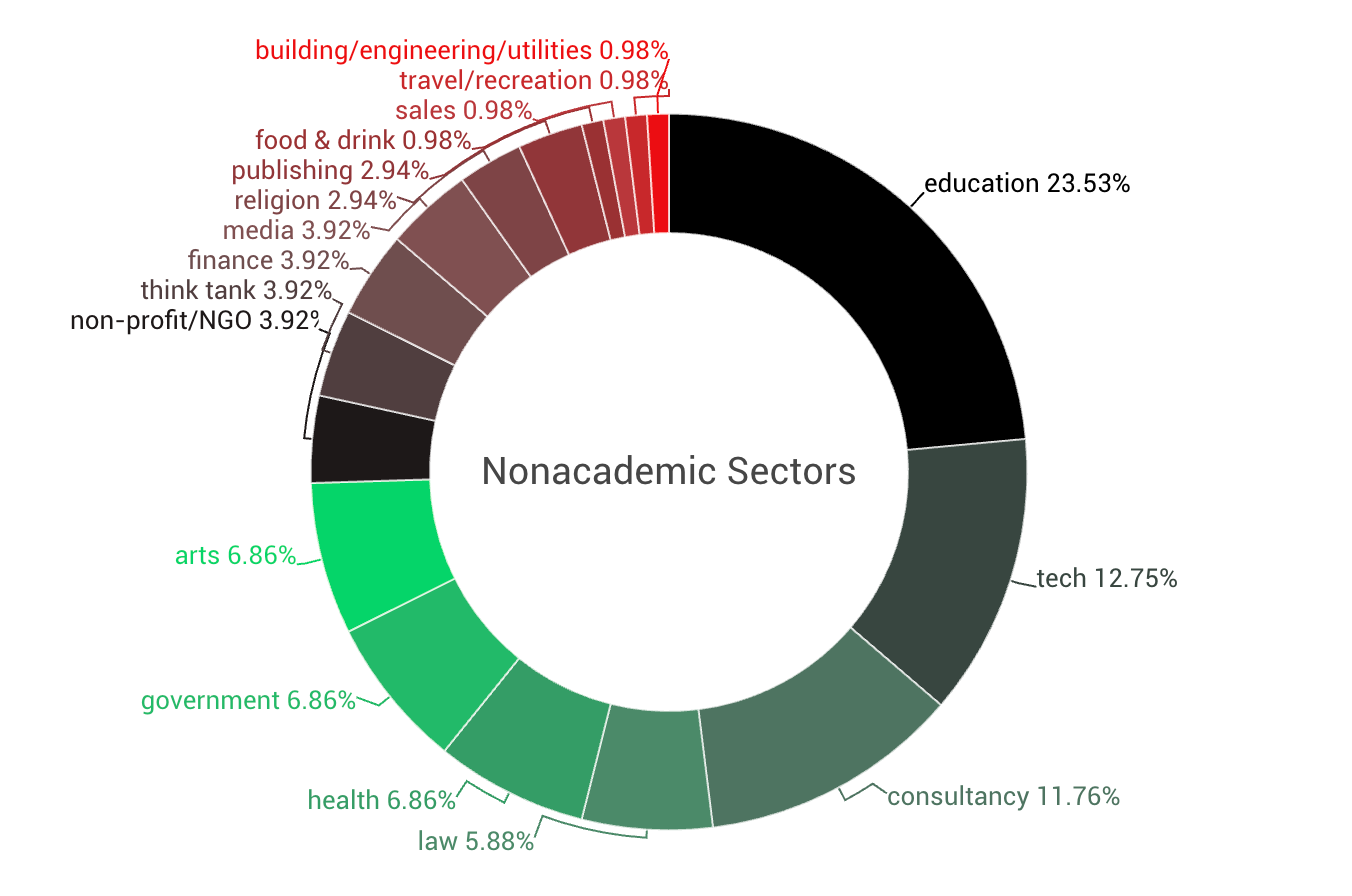
In terms of the types of nonacademic jobs philosophy graduates find, those continue to be largely in the education sector (e.g. alt-ac careers and high school teaching), followed by technology, consultancy, law, health, government, and the arts (see the chart below).
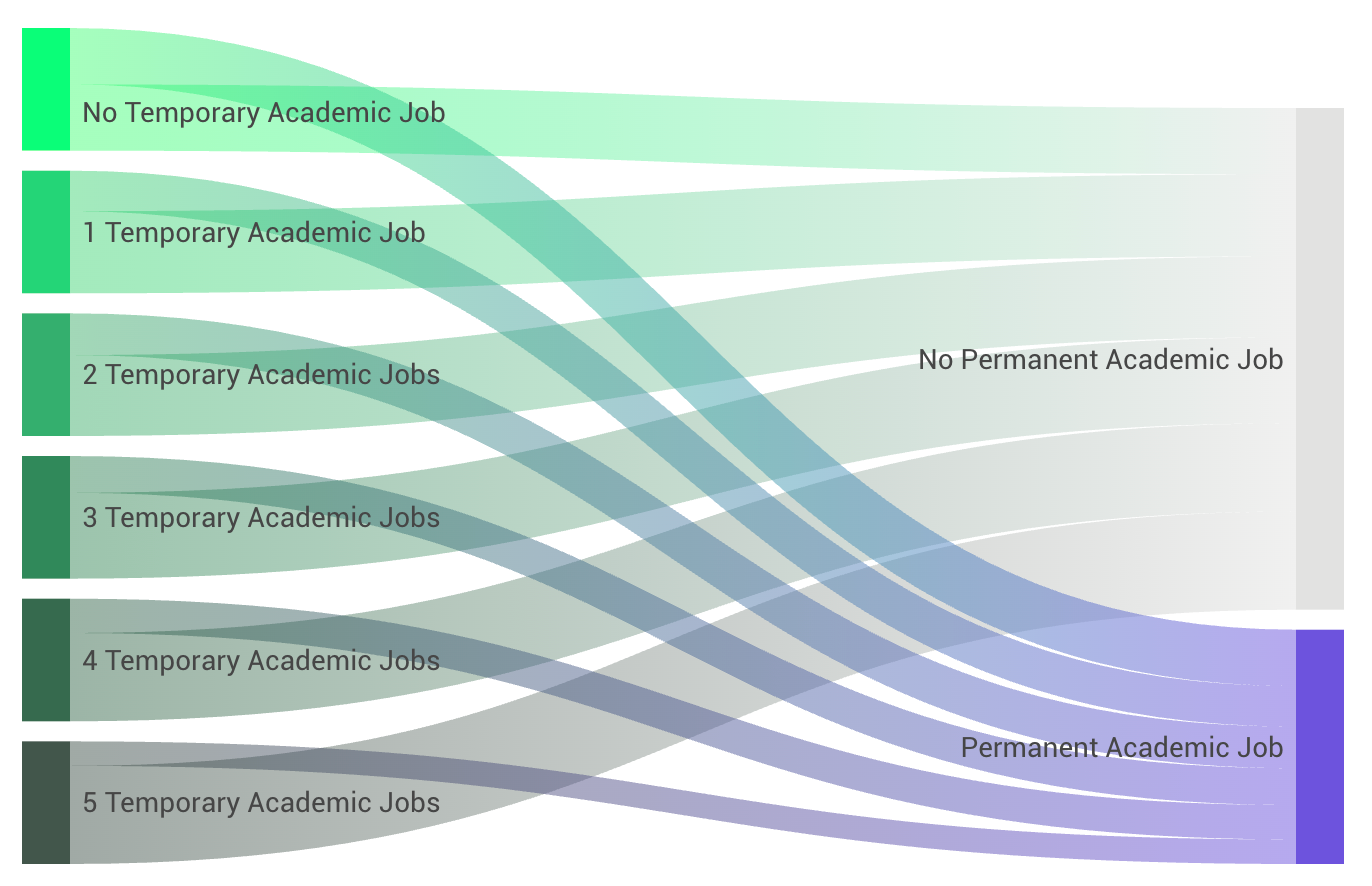
It also continues to be the case that the plurality of those with permanent academic employment find it without taking intermediary temporary jobs. This chart shows the proportion of 2014–2024 graduates with permanent academic employment and between 0 and 5 temporary academic jobs to illustrate this.
In terms of specific graduate programs, a number of programs have permanent academic placement rates (the number in permanent academic jobs divided by all graduates) that are higher than in 2024. Those with at least 10 graduates and a 10% or greater increase in permanent academic placement rate are: Arizona State University (now 60%), University College London (40%), University of Alberta (58%), University of Arkansas (17%), University of Calgary (31%), University of Oklahoma (48%), and University of York (44%). Others have lower permanent academic placement rates compared to 2024: Australian National University (now 24%), Indiana University Bloomington (HPS, 25%), and University of Cambridge (HPS, 36%).
In 2026, top 10 for permanent academic placement are: University of Southern California (39 of 54 graduates; 72%), University of Virginia (26/36=72%), Baylor University (32/45=71%), University of Cincinnati (17/24=71%), Boston University (29/41=71%), Rutgers University (42/61=69%), Dalhousie University (4/6=67%), University of Michigan (40/60=67%), Yale University (38/58=66%), and New York University (35/54=65%). 71 programs had permanent academic placement rates over 40% (the overall rate for graduates across all programs), which are listed in order of placement rate below**.
Program Rating
In the 2025 survey, as in past years, we asked participants whether they would recommend their program to a prospective student, with participants including current students and graduates of the past 10 years ("How likely would you be to recommend this program to prospective PhD students?"). The mean for 2025 participants (n=1185) was 4.15, an increase from the mean for 2023 participants (n=1091), which was 3.98 (p<.001).
For the 2025 survey, top 10 for overall program ratings are: University of Southern California (n=32, 4.9), University of California San Diego (n=8, 4.9), Baylor University (n=15, 4.9), Duke University (n=5, 4.8), University of Kansas (n=5, 4.8), University of California Riverside (n=5, 4.8), Australian National University (n=23, 4.8), University of Pennsylvania (n=17, 4.8), University of Sheffield (n=8, 4.8), and University of Wisconsin Madison (n=18, 4.7). 36 programs had ratings over 4.15, listed below***.
A number of programs had higher ratings this year. Including just those with 5 or more participants and more than .5 difference between the scores, Temple University (n=5, mean of 3.6, +1.1 from 2023), University of Hawai'i at Manoa (n=5, 3.6, +1), University of Wisconsin Madison (n=18, 4.7, +.8), DePaul University (n=9, 3.9, +.8), University of California Irvine (n=6, 4.0, +.7), Purdue University (n=10, 3.9, +.7), Fordham University (n=12, 3.9, +.7), Western University (n=16, 3.5, +.7), University of Southern California (n=32, 4.9, +.6), Duke University (n=5, 4.8, +.6), and University of Washington (n=10, 4.1, +.6) had higher ratings.
Other programs had lower ratings compared with 2023: Pennsylvania State University (n=5, 3.2, -1.1), University of Kentucky (n=11, 3.3, -.9), Boston College (n=8, 3.8, -.9), Carnegie Mellon University (n=5, 3.2, -.7), The Catholic University of America (n=6, 4.2, -.6), University of South Carolina (n=8, 3.4, -.6), University of Nebraska Lincoln (n=8, 3.4, -.6), and Washington University St. Louis (n=13, 3.8, -.6).
Climate Rating
Finally, we can compare climate ratings across the two surveys ("Rate your satisfaction with this program’s efforts to foster a healthy, respectful academic culture or climate"). The mean for 2025 participants (n=1179) was 4.03; the mean for 2023 participants (n=1088) was 3.88—a recent increase (p<.01).
The top 10 for climate ratings in the 2025 survey are: University of California San Diego (n=8, 4.9), University of Maryland College Park (n=5, 4.6), London School of Economics and Political Science (n=7, 4.6), University of Pennsylvania (n=17, 4.5), University of North Carolina at Chapel Hill (n=20, 4.5), University of Sheffield (n=8, 4.5), University of Southern California (n=32, 4.5), New York University (n=28, 4.5), University of Utah (n=9, 4.4), and University of Cincinnati (n=14, 4.4). 35 programs had ratings over 4.03, listed below****.
Programs with higher climate ratings, when compared with 2023, are: Purdue University (n=10, mean of 3.5, change of +1.3 from 2023), University of Hawai'i at Manoa (n=5, 3.8, +1), DePaul University (n=9, 3.3, +1), Katholieke Universiteit Leuven (n=7, 4.1, +.9), University of Southern California (n=32, 4.5, +.9), University of California Irvine (n=6, 4.0, +.9), University of Pittsburgh (HPS, n=19, 4.1, +.9), University of Miami (n=8, 3.6, +.8), Duke University (n=5, 4.4, +.7), Northwestern University (n=15, 4.1, +0.7), Western University (n=15, 3.4, +.7), Vanderbilt University (n=7, 4.0, +.6), and University of Maryland College Park (n=5, 4.6, +.6).
Programs with lower ratings, compared with 2023 are: University of Nebraska, Lincoln (n=8, mean of 2.5, change of -2.2), Saint Louis University (n=7, 3.9, -.9), Boston College (n=8, 3.3, -.9), University of Kansas (n=5, 3.8, -.8), Ohio State University (n=10, 3.4, -.7), Binghamton University (n=7, 3.3, -.7), Washington University St. Louis (n=14, 4.0, -0.7), University of Virginia (n=6, 4.0, -0.7), and The Catholic University of America (n=6, 4.3, -0.7).
While reading the program comments across the two surveys, I had the subjective sense of a greater proportion mentioning issues related to harassment, bullying, and other problematic behaviors, despite the increase in climate rating. I used Claude (AI) to help compare the comments across the two years (including only the public responses and no other data) with the prompt "Can you count how many entries in the following mention bullying, harassment, or other problematic behavior?" Claude found that 4% of the 2025 entries and 3% of the 2023 entries did this—a slight uptick. Claude noted its use of the following keywords in 2025 (verbatim from Claude): sexual harassment, racist/racism, sexist/sexism, homophobic/homophobia, toxic behavior, hostile environments, discrimination, and harassment (general). For 2023 it identified similar keywords or themes (verbatim from Claude): toxic competition and faculty conflict, harassment (unreported faculty harassers mentioned), racist attitudes and discrimination, sexist/sexism, hostile environments (particularly toward feminists), intimidating and competitive atmospheres, and discrimination against underrepresented groups. When I asked Claude to focus on a comparison across the two focused more narrowly on Title-IX related issues, it found twice as many mentions in 2025 as in 2023. Worth noting is that these numbers were not verified by hand and that AI is fallible.
Keywords
Participants of the survey are asked to select keywords that define their graduate program ("Select from this list up to 5 keywords that you would associate with this program."). Of these, some keywords have gained in popularity since 2023. Namely, Political/Social (3% to 5% of mentions), Analytic (11 to 12%), and Technology (0 to 1%) all increased. Losses were seen in Race (1.4% to .8%) and Logic/Formal (5% to 4%). To focus on just two of the smaller ones: 3 programs were associated with "technology" by at least three participants in 2025 (0 in 2023)—Eindhoven, Kansas, and Toronto (IHST). While 7 programs were associated with "race" in 2023 (CUNY, Penn State, Memphis, U Penn, Loyola, Marquette, and Northwestern), only 5 were in 2025 (CUNY, Penn State, Memphis, U Penn, and Emory).
Addenda
| Completion Date | Program Name | APDA Page |
| 8/21/25 | Arizona State University | https://philosophydata.org/data/132 |
| 8/25/25 | Arizona State University (HPS) | https://philosophydata.org/data/5413 |
| 8/25/25 | Australian National University | https://philosophydata.org/data/469 |
| 8/27/25 | Baylor University | https://philosophydata.org/data/76 |
| 8/27/25 | Binghamton University | https://philosophydata.org/data/258 |
| 8/27/25 | Bogazici University | https://philosophydata.org/data/1001 |
| 9/10/25 | Boston College | https://philosophydata.org/data/38 |
| 9/10/25 | Boston University | https://philosophydata.org/data/366 |
| 9/10/25 | Bowling Green State University | https://philosophydata.org/data/101 |
| 9/10/25 | Brown University | https://philosophydata.org/data/119 |
| 9/10/25 | Carnegie Mellon University | https://philosophydata.org/data/207 |
| 9/10/25 | Columbia University | https://philosophydata.org/data/299 |
| 9/10/25 | Cornell University | https://philosophydata.org/data/69 |
| 9/10/25 | Dalhousie University | https://philosophydata.org/data/561 |
| 8/25/25 | Deakin University | https://philosophydata.org/data/473 |
| 11/7/25 | DePaul University | https://philosophydata.org/data/278 |
| 11/7/25 | Duke University | https://philosophydata.org/data/327 |
| 11/7/25 | Duquesne University | https://philosophydata.org/data/148 |
| 11/7/25 | Durham University | https://philosophydata.org/data/527 |
| 11/7/25 | Eindhoven University of Technology | https://philosophydata.org/data/1184 |
| 11/11/25 | Emory University | https://philosophydata.org/data/474 |
| 11/11/25 | Florida State University | https://philosophydata.org/data/218 |
| 11/11/25 | Fordham University | https://philosophydata.org/data/116 |
| 11/11/25 | Georgetown University | https://philosophydata.org/data/475 |
| 11/11/25 | Graduate Center of the City University of New York | https://philosophydata.org/data/245 |
| 11/19/25 | Harvard University | https://philosophydata.org/data/528 |
| 11/19/25 | Indiana University Bloomington | https://philosophydata.org/data/375 |
| 11/19/25 | Indiana University Bloomington (HPS) | https://philosophydata.org/data/556 |
| 11/7/25 | Institut Jean Nicod | https://philosophydata.org/data/478 |
| 11/19/25 | Johns Hopkins University | https://philosophydata.org/data/397 |
| 11/7/25 | King´s College London | https://philosophydata.org/data/480 |
| 12/7/25 | London School of Economics and Political Science | https://philosophydata.org/data/483 |
| 11/19/25 | Loyola University Chicago | https://philosophydata.org/data/150 |
| 11/7/25 | Marquette University | https://philosophydata.org/data/488 |
| 11/7/25 | Massachusetts Institute of Technology | https://philosophydata.org/data/313 |
| 11/14/25 | McGill University | https://philosophydata.org/data/485 |
| 11/30/25 | McMaster University | https://philosophydata.org/data/486 |
| 11/14/25 | Michigan State University | https://philosophydata.org/data/86 |
| 1/13/26 | National University of Singapore | https://philosophydata.org/data/901 |
| 11/14/25 | New York University | https://philosophydata.org/data/34 |
| 11/14/25 | Northwestern University | https://philosophydata.org/data/97 |
| 11/14/25 | Ohio State University | https://philosophydata.org/data/68 |
| 1/16/26 | Pennsylvania State University | https://philosophydata.org/data/164 |
| 11/14/25 | Princeton University | https://philosophydata.org/data/490 |
| 11/14/25 | Purdue University | https://philosophydata.org/data/491 |
| 1/16/26 | Rutgers University | https://philosophydata.org/data/531 |
| 11/21/25 | Saint Louis University | https://philosophydata.org/data/176 |
| 11/21/25 | Southern Illinois University | https://philosophydata.org/data/532 |
| 1/23/26 | St Andrews and Stirling Graduate Programme in Philosophy | https://philosophydata.org/data/560 |
| 11/21/25 | Stanford University | https://philosophydata.org/data/178 |
| 1/16/26 | Stony Brook University | https://philosophydata.org/data/493 |
| 11/21/25 | Syracuse University | https://philosophydata.org/data/2 |
| 11/21/25 | Temple University | https://philosophydata.org/data/142 |
| 11/21/25 | Texas A & M University-College Station | https://philosophydata.org/data/3619 |
| 1/17/26 | The Catholic University of America | https://philosophydata.org/data/525 |
| 1/17/26 | The New School | https://philosophydata.org/data/494 |
| 3/12/25 | The University of Manchester | https://philosophydata.org/data/542 |
| 1/17/26 | The University of Melbourne | https://philosophydata.org/data/510 |
| 1/17/26 | The University of Western Australia | https://philosophydata.org/data/549 |
| 1/17/26 | Tilburg University | https://philosophydata.org/data/495 |
| 1/17/26 | Trinity College, Dublin | https://philosophydata.org/data/572 |
| 11/30/25 | Tulane University | https://philosophydata.org/data/37 |
| 2/12/25 | Universite de Montreal | https://philosophydata.org/data/570 |
| 11/30/25 | University at Albany | https://philosophydata.org/data/330 |
| 11/30/25 | University at Buffalo | https://philosophydata.org/data/539 |
| 1/23/26 | University College London | https://philosophydata.org/data/497 |
| 1/17/26 | University of Alberta | https://philosophydata.org/data/534 |
| 11/30/25 | University of Arizona | https://philosophydata.org/data/429 |
| 11/30/25 | University of Arkansas | https://philosophydata.org/data/1108 |
| 1/17/26 | University of Auckland | https://philosophydata.org/data/535 |
| 1/17/26 | University of British Columbia | https://philosophydata.org/data/538 |
| 1/31/26 | University of Calgary | https://philosophydata.org/data/540 |
| 11/30/25 | University of California, Berkeley | https://philosophydata.org/data/181 |
| 11/30/25 | University of California, Davis | https://philosophydata.org/data/443 |
| 12/5/25 | University of California, Irvine | https://philosophydata.org/data/12 |
| 12/5/25 | University of California, Irvine (LPS) | https://philosophydata.org/data/557 |
| 12/5/25 | University of California, Los Angeles | https://philosophydata.org/data/11 |
| 12/5/25 | University of California, Riverside | https://philosophydata.org/data/143 |
| 12/5/25 | University of California, San Diego | https://philosophydata.org/data/441 |
| 12/5/25 | University of California, Santa Barbara | https://philosophydata.org/data/292 |
| 12/5/25 | University of California, Santa Cruz | https://philosophydata.org/data/296 |
| 1/31/26 | University of Cambridge | https://philosophydata.org/data/499 |
| 1/31/26 | University of Cambridge (HPS) | https://philosophydata.org/data/500 |
| 12/12/25 | University of Chicago | https://philosophydata.org/data/448 |
| 1/31/26 | University of Chicago (CHSS) | https://philosophydata.org/data/558 |
| 12/12/25 | University of Cincinnati | https://philosophydata.org/data/87 |
| 12/12/25 | University of Colorado Boulder | https://philosophydata.org/data/260 |
| 12/12/25 | University of Connecticut | https://philosophydata.org/data/233 |
| 12/12/25 | University of Dallas | https://philosophydata.org/data/455 |
| 1/31/26 | University of Edinburgh | https://philosophydata.org/data/502 |
| 12/12/25 | University of Florida | https://philosophydata.org/data/234 |
| 1/31/26 | University of Geneva | https://philosophydata.org/data/575 |
| 1/31/26 | University of Georgia | https://philosophydata.org/data/332 |
| 1/31/26 | University of Graz | https://philosophydata.org/data/578 |
| 1/31/26 | University of Guelph | https://philosophydata.org/data/507 |
| 1/31/26 | University of Hawai´i at Manoa | https://philosophydata.org/data/223 |
| 1/31/26 | University of Hong Kong | https://philosophydata.org/data/1259 |
| 1/31/26 | University of Illinois at Chicago | https://philosophydata.org/data/28 |
| 1/31/26 | University of Illinois at Urbana-Champaign | https://philosophydata.org/data/356 |
| 1/31/26 | University of Iowa | https://philosophydata.org/data/241 |
| 1/31/26 | University of Kansas | https://philosophydata.org/data/319 |
| 1/31/26 | University of Kentucky | https://philosophydata.org/data/248 |
| 1/31/26 | University of Maryland, College Park | https://philosophydata.org/data/212 |
| 1/31/26 | University of Massachusetts Amherst | https://philosophydata.org/data/289 |
| 1/12/25 | University of Memphis | https://philosophydata.org/data/511 |
| 11/28/25 | University of Miami | https://philosophydata.org/data/417 |
| 11/28/25 | University of Michigan | https://philosophydata.org/data/361 |
| 11/27/25 | University of Minnesota Twin Cities | https://philosophydata.org/data/543 |
| 11/27/25 | University of Missouri | https://philosophydata.org/data/317 |
| 11/27/25 | University of Nebraska, Lincoln | https://philosophydata.org/data/156 |
| 11/27/25 | University of New Mexico | https://philosophydata.org/data/461 |
| 11/26/25 | University of North Carolina at Chapel Hill | https://philosophydata.org/data/436 |
| 11/26/25 | University of Notre Dame | https://philosophydata.org/data/314 |
| 11/26/25 | University of Nottingham | https://philosophydata.org/data/639 |
| 11/26/25 | University of Oklahoma | https://philosophydata.org/data/433 |
| 11/26/25 | University of Oregon | https://philosophydata.org/data/322 |
| 11/26/25 | University of Otago | https://philosophydata.org/data/544 |
| 11/24/25 | University of Oxford | https://philosophydata.org/data/512 |
| 11/24/25 | University of Pennsylvania | https://philosophydata.org/data/135 |
| 11/24/25 | University of Pittsburgh | https://philosophydata.org/data/19 |
| 11/24/25 | University of Pittsburgh (HPS) | https://philosophydata.org/data/559 |
| 11/24/25 | University of Reading | https://philosophydata.org/data/546 |
| 11/24/25 | University of Rochester | https://philosophydata.org/data/102 |
| 11/22/25 | University of Salzburg | https://philosophydata.org/data/10030 |
| 11/22/25 | University of Sheffield | https://philosophydata.org/data/514 |
| 11/22/25 | University of South Carolina | https://philosophydata.org/data/58 |
| 11/21/25 | University of South Florida | https://philosophydata.org/data/18 |
| 11/21/25 | University of Southern California | https://philosophydata.org/data/188 |
| 11/21/25 | University of Tennessee | https://philosophydata.org/data/423 |
| 11/19/25 | University of Texas at Austin | https://philosophydata.org/data/21 |
| 11/19/25 | University of Toronto | https://philosophydata.org/data/547 |
| 11/20/25 | University of Toronto (IHPST) | https://philosophydata.org/data/5414 |
| 11/15/25 | University of Utah | https://philosophydata.org/data/202 |
| 11/15/25 | University of Virginia | https://philosophydata.org/data/421 |
| 11/15/25 | University of Warwick | https://philosophydata.org/data/519 |
| 12/11/25 | University of Washington | https://philosophydata.org/data/95 |
| 12/11/25 | University of Waterloo | https://philosophydata.org/data/520 |
| 12/11/25 | University of Wisconsin-Madison | https://philosophydata.org/data/77 |
| 12/11/25 | University of York | https://philosophydata.org/data/551 |
| 12/11/25 | Uppsala University | https://philosophydata.org/data/584 |
| 12/11/25 | Vanderbilt University | https://philosophydata.org/data/41 |
| 12/11/25 | Victoria University of Wellington | https://philosophydata.org/data/521 |
| 12/11/25 | Villanova University | https://philosophydata.org/data/221 |
| 12/11/25 | Washington University in St. Louis | https://philosophydata.org/data/48 |
| 12/11/25 | Wayne State University | https://philosophydata.org/data/552 |
| 11/11/25 | Western University | https://philosophydata.org/data/550 |
| 11/2/25 | William Marsh Rice University | https://philosophydata.org/data/553 |
| 11/2/25 | Yale University | https://philosophydata.org/data/524 |
| 11/2/25 | York University | https://philosophydata.org/data/554 |
*Programs contacted but not yet covered by APDA: Bielefeld University, Bilkent University, Birkbeck, University of London, Cardiff University, Central European University, Chinese University of Hong Kong, Delft University of Technology, FINO Northwestern Italian Philosophy Consortium, Free University of Berlin, Goethe University Frankfurt, Humboldt University of Berlin, Johannes Gutenberg University of Mainz, Katholieke Universiteit Leuven, Kingston University, La Trobe University, Leipzig University, Ludwig Maximilian University of Munich, Macquarie University, Middle East Technical University, Monash University, National Autonomous University of Mexico, Pantheon-Sorbonne University, Royal Holloway, University of London, Ruhr University Bochum, Scuola Normale Superiore di Pisa, Stockholm University, Texas State University, TU Bergakademie Freiberg, University of Aberdeen, University of Adelaide, University of Amsterdam, University of Antwerp, University of Barcelona, University of Birmingham, University of Bristol, University of Buenos Aires, University of Cologne, University of Dundee, University of East Anglia, University of Erfurt, University of Glasgow, University of Groningen, University of Hannover, University of Helsinki, University of Hong Kong, University of Leeds, University of Lugano, University of Milan, University of Modena, University of Murcia, University of New South Wales, University of Oslo, University of Ottawa, University of Padua, University of Sussex, The University of Sydney,University of Sydney HPS, University of Tasmania, University of Tehran, University of the Basque Country, University of Tübingen, University of Valencia, University of Vienna, University of Waikato, and Vrije Universiteit Brussel
**Programs with higher than the overall permanent academic placement rate, listed by rate (from highest/72% to lowest/41%): University of Southern California (72%), University of Virginia (72%), Baylor University, University of Cincinnati, Boston University, Rutgers University, Dalhousie University, University of Michigan, Yale University, New York University, The Catholic University of America, Pennsylvania State University, Arizona State University, Vanderbilt University, Massachusetts Institute of Technology, Stony Brook University, University of Arizona, University of Alberta, University of Wisconsin-Madison, University of Massachusetts Amherst, Emory University, University of Pittsburgh (HPS), Princeton University, Duke University, Columbia University, University of California Irvine (LPS), Saint Louis University, University of Washington, Washington University in St. Louis, University of California Berkeley, University of Pennsylvania, Stanford University, University of Auckland, University of California Santa Barbara, University of Georgia, University of Kansas, University of Kentucky, William Marsh Rice University, University of Toronto, Boston College, Harvard University, University of California San Diego, University of California Los Angeles, University of Hawai'i at Manoa, University of Oklahoma, University of Pittsburgh, Texas A & M University-College Station, Georgetown University, University at Buffalo, University of Illinois at Chicago, Purdue University, University of North Carolina at Chapel Hill, University of Chicago, University of Texas at Austin, Carnegie Mellon University, University of Memphis, Temple University, York University, Northwestern University, University of Miami, Cornell University, University of Notre Dame, Syracuse University, Villanova University, Indiana University Bloomington, Michigan State University, University of Oregon, Wayne State University, Bowling Green State University (41%), University of Illinois at Urbana-Champaign (41%), and DePaul University (41%).
***Programs with higher than the mean program rating, listed by rating (from highest/4.9 to lowest/4.2): University of Southern California (4.9), University of California San Diego (4.9), Baylor University (4.9), Duke University, University of Kansas, University of California Riverside, Australian National University, University of Pennsylvania, University of Sheffield, University of Wisconsin-Madison, London School of Economics and Political Science, University of Cincinnati, University of Michigan, Georgetown University, University of Massachusetts Amherst, St Andrews and Stirling Graduate Programme in Philosophy, University of Pittsburgh (HPS), Harvard University, New York University, University of North Carolina at Chapel Hill, University of California Berkeley, Yale University, University of Toronto, University of Warwick, York University, University of Utah, Cornell University, University of California Irvine (LPS), Northwestern University, University of Chicago, University of Memphis (4.2), University of Oxford (4.2), Indiana University Bloomington (4.2), Massachusetts Institute of Technology (4.2), Fordham University (4.2), and The Catholic University of America (4.2).
****Programs with higher than the mean climate rating, listed by rating (from highest/4.9 to lowest/4.1): University of California San Diego (4.9), University of Maryland College Park, London School of Economics and Political Science, University of Pennsylvania, University of North Carolina at Chapel Hill, University of Sheffield, University of Southern California, New York University, University of Utah, University of Cincinnati, Duke University, University of Wisconsin-Madison, University of California Berkeley, University of Michigan, Baylor University, The Catholic University of America, Australian National University, University of Arizona, University of California Irvine (LPS), St Andrews and Stirling Graduate Programme in Philosophy, York University, Cornell University, Yale University, Georgetown University, Harvard University, University of South Florida, Fordham University, Katholieke Universiteit Leuven (4.1), University of British Columbia (4.1), Northwestern University (4.1), University of Massachusetts Amherst (4.1), University of Toronto (4.1), University of California Los Angeles (4.1), University of Notre Dame (4.1), and University of Pittsburgh (HPS, 4.1).