2025 Survey Results: Publications and Teaching in Academia (Part I - Professional Norms and Academic Outcomes)

In this first of a series of posts on professional norms and academic outcomes, we examine the dual pillars of the academic portfolio: how much publication and teaching experience is “enough” to secure a stable career? Is a modest record at graduation sufficient, or is there an implicit expectation that scholars substantially expand both their research and instructional portfolios during postdoctoral or contingent employment years? To explore these questions, we analyse a decade of data tracking graduates from 2014 through 2025 solicited from the 2025 APDA survey.
The short synopsis is this: while both publication counts and teaching volume increase steadily across career stages, they follow distinct paths. Publication counts show a “more is better” signal for academic retention, with a portfolio of roughly 4–5 articles being typical by the time scholars secure their first permanent position. In contrast, teaching experience appears to reach a point of diminishing returns; those who secure permanent roles often graduate with less total teaching volume than those in contingent roles, suggesting that institutional prestige and formal pedagogical support often outweigh raw instructional quantity.
Importantly, our analysis reveals that these two metrics are statistically independent. There is no evidence of a “trade-off” between teaching and publication experience, where focusing on one detracts from the other; rather, they represent two separate pipelines shaped by departmental funding models, institutional prestige, and disciplinary norms.
Summary Statistics
We begin with summary statistics across key career stages.
Publications. Current students report a mean of 1.26 articles (median = 0, n = 165), indicating that most current students (across all years) have not yet published. At graduation, the mean rises to 2.01 articles (median = 1, n = 296). By the time of first permanent position, the mean increases to 5.45 articles (median = 4, n = 255).
Book publications remain comparatively rare at early stages: even among those in permanent roles, the mean number of books is 0.51 (median = 0, n = 255), with a small number of highly productive individuals raising the average.
| Career Stage | Mean (Avg.) | Median | Max | Sample (n) |
|---|---|---|---|---|
| Current Student (Articles) |
1.26 | 0 | 12 | 165 |
| At Graduation (Articles) |
2.01 | 1 | 25 | 296 |
| At Time of First Permanent Position (Articles) |
5.45 | 4 | 50 | 255 |
| At Time of First Permanent Position (Books) |
0.51 | 0 | 10 | 255 |
These figures illustrate a clear “publication pipeline”. Among current students, more than half report zero publications, reflecting early-stage enrolment. By graduation, the distribution shifts, with one publication becoming the most common outcome. At the point of permanent hire, the distribution becomes strongly right-skewed: while the median is 4 articles, a small subset of respondents reports between 10 and 50 publications, pulling the mean upward. (This skew is a recurring feature throughout the dataset.)
Survey Note: For current students, we asked “Approximately how many peer-reviewed or invited publications (articles, chapters, or equivalent works) have you published or are accepted for publication? (Exclude book reviews, commentaries, or short pieces.)”. For those who have graduated, we asked “At the time of graduation, approximately how many peer-reviewed or invited publications (articles, chapters, or equivalent works) had you published or were accepted for publication? (Exclude book reviews, commentaries, or short pieces.)”, and for those who reported a permanent academic position, we additionally asked “At the time you were hired into your first permanent academic position, approximately how many peer-reviewed or invited publications (articles, chapters, or equivalent works) had you published or were accepted for publication? (Exclude book reviews, commentaries, or short pieces.)”. Each question included a slider [0, 50].
Teaching. Considering summary statistics across key career stages for teaching experience, current students report a mean of 2.69 unique course types taught as “instructor of record” (median = 2.0, n = 264), indicating that unlike publications, most graduate students begin accumulating independent teaching experience early in their programmes. At graduation, the mean rises to 4.95 course types (median = 3.0, n = 618). By the time of first permanent position, the mean increases to 7.46 course types (median = 5.0, n = 371).
The volume of teaching, measured in total course offerings (tokens), follows a similar upward trajectory steadily increasing from current student (mean = 4.40, median = 2.0, n = 205) to graduation (mean = 8.77, median = 5.0, n = 535) to first permanent hire (mean = 11.07, median = 8.0, n = 336). Even at the earliest stages, students have typically taught several distinct course offerings and several duplicate sections, and this number approximately doubles by the time a permanent hire is secured.
| Career Stage | Mean (Avg.) | Median | Min | Max | Sample Size (n) |
|---|---|---|---|---|---|
| Current Student (Type) |
2.69 | 2.0 | 0 | 27 | 264 |
| Current Student (Token) |
4.40 | 2.0 | 0 | 50 | 205 |
| At Graduation (Type) |
4.95 | 3.0 | 0 | 50 | 618 |
| At Graduation (Token) |
8.77 | 5.0 | 0 | 50 | 535 |
| At First Permanent Hire (Type) |
7.46 | 5.0 | 0 | 50 | 371 |
| At First Permanent Hire (Token) |
11.07 | 8.0 | 0 | 50 | 336 |
As with publication, these figures illustrate a steady “teaching pipeline”. Among current students, the majority have already served as instructors of record, perhaps reflecting the heavy reliance on graduate student labour in the discipline. By graduation, the distribution shifts, with three distinct course types becoming the most common threshold. At the point of permanent hire, the distribution remains right-skewed: while the median is 5 unique course types and 8 total offerings, a subset of respondents reports teaching as many as 50 courses (note that this was the maximum value allowed in the survey), pulling the mean upward. This skew suggests that while a moderate teaching load is standard, a significant portion of the candidate pool enters permanent positions with extremely high volumes of instructional experience.
Survey Note: For current students, we asked “Approximately how many courses have you taught as the instructor of record?”. For those who have graduated, we asked “At the time of graduation, approximately how many courses have you taught as the instructor of record?”, and for those who reported a permanent academic position, we additionally asked “At the time you were hired into your first permanent academic position, approximately how many courses have you taught as the instructor of record?”. Each question included separate sliders [0, 50] for types and tokens.
The Publication Pipeline
One notable pattern in the publication pipeline is the “graduation gap”: the transition from current student to graduate is associated with a substantial increase in output, with average publication counts rising by approximately 60%. (This is partly explained by the variance in time between those who count as “current students”—i.e., 1st year PhD candidates, who are less likely to have a publication, versus ABD candidates, who are more likely to have a publication.)
A second pattern is the “permanent threshold”: although there is no strict cutoff, the typical successful candidate has accumulated several additional publications after graduation, bringing their total to approximately 4–5 articles by the time of permanent hire.
Across all years, publication counts exhibit high variability. In most cohorts, the standard deviation exceeds the mean, and the range extends from 0 to as many as 30+ articles at graduation. This indicates a highly skewed distribution in which a small number of outliers significantly influence averages, while the median remains comparatively low (often between 0 and 2 publications).
Trends across Time
Publication Rates. When we examine trends over time, publication rates at graduation remain relatively stable. The mean number of articles fluctuates between roughly 2 and 4 across cohorts from 2014 to 2025, with no significant upward or downward trend. Although there is a slight negative slope in the data, it is not statistically significant, and year-to-year variability is substantial. In short, despite (potentially) common perceptions that publication expectations are rising, the baseline number of articles at graduation has remained broadly consistent over the past decade.
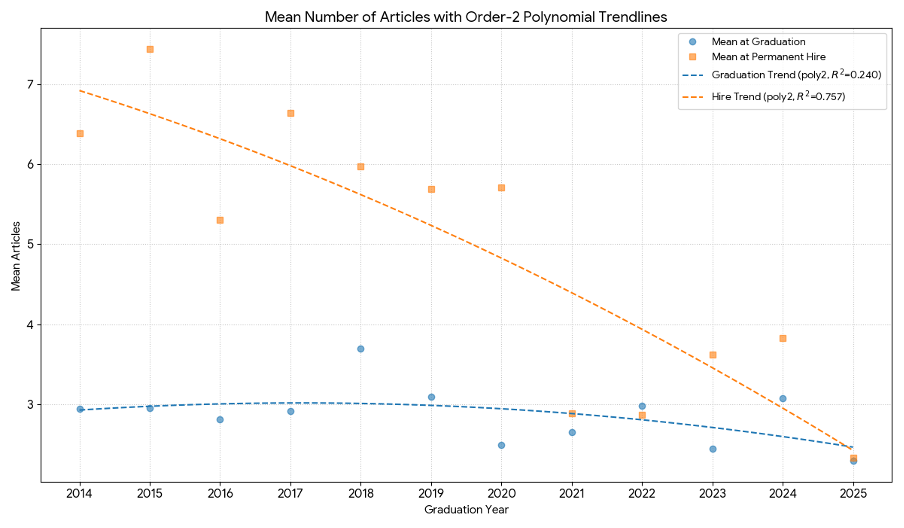
Note that the apparent decline in the average number of publications at the time of permanent hire (orange trend line) is largely an artefact of timing. Specifically, individuals who obtain permanent academic positions immediately after completing their PhD will typically have fewer publications than those who spend several years in temporary positions before being hired permanently. As a result, more recent cohorts—which include a higher proportion of immediate hires—tend to show lower publication counts at hire. Historically, candidates who do not secure immediate permanent positions tend to roughly double their publication count in the years following graduation before eventually obtaining a permanent position.
Teaching. When we examine trends over time for teaching experience, we find similar results. Teaching experience at graduation remains relatively stable. The average number of unique course types taught remains roughly between 3.5 and 6 (median, 3-4) across cohorts from 2014 to 2025, while total course offerings (tokens) fluctuate with no statistically significant upward or downward trend (p = 0.800 for types; p = 0.0725 for tokens). Although there is a slight negative slope in the token data (-0.1834 per year), it is not statistically significant, and year-to-year variability is substantial. The baseline amount of teaching experience accumulated by the time of graduation has remained broadly consistent over the past decade.
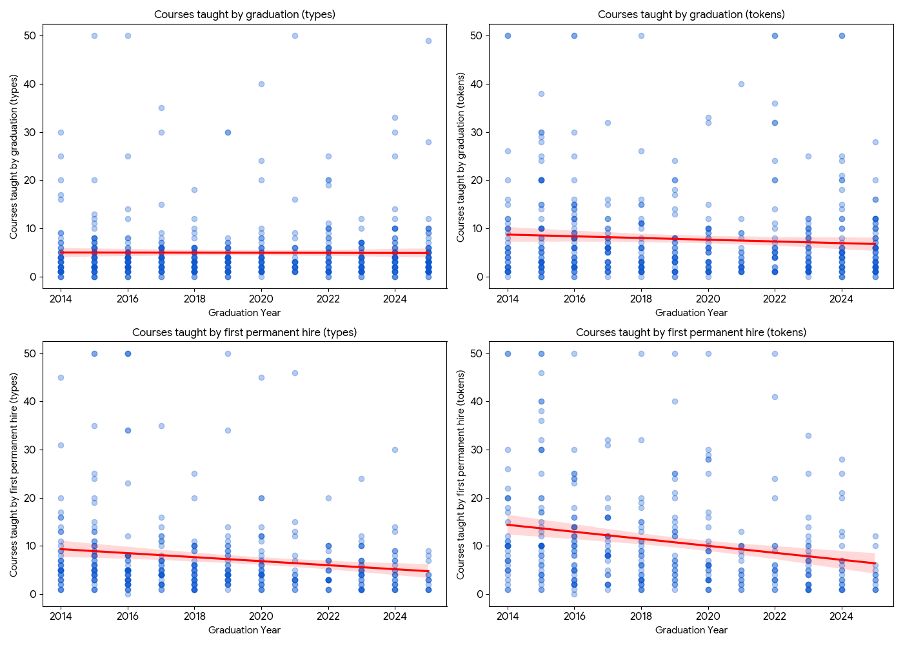
As with publications, the statistically significant downward trend in average courses taught at the time of permanent hire (p < 0.001 for tokens; p = 0.002 for types) is largely an artefact of timing. Recent graduates (2024–2025) who have already secured permanent positions are “fast hires” who moved into permanent roles immediately; as such, they have not yet had the experience of post-PhD teaching that older cohorts would have accumulated. For example, the 2015 cohort added an average of 5.02 additional course types and 7.28 additional course tokens between graduation and their first permanent position.
Career Outcomes
Publications. Turning to career outcomes, publication counts at graduation differ systematically by eventual job type. Graduates who secure permanent academic roles report higher average publication counts (mean = 2.62, median = 2) than those in contingent roles (mean = 1.48, median = 1) or non-academic careers (mean = 0.78, median = 0). Again, although there is no absolute threshold, the data suggests that having at least one or two publications at graduation is associated with a substantially higher likelihood of remaining in academia.
Books play a more limited but still meaningful role. Only a minority of permanent academics report having a book or book contract at the time of hire, and books are concentrated in specific subfields (e.g., continental philosophy and history of philosophy). There is some evidence of a substitution effect: candidates with books may require fewer articles, whereas those without books typically rely on a larger number of articles to remain competitive.
Teaching. Teaching experience at graduation does not show the same systematic upward trend for permanent academic positions that publication counts do. In fact, graduates who secure permanent academic roles tend to report slightly lower median teaching levels at graduation (mean = 4.95, median = 3.0 course types) than those in contingent academic roles (mean = 4.98, median = 4.0) or non-academic careers (mean = 5.19, median = 4.0). This suggests that while a baseline of experience is required, “more” is not necessarily better for securing a permanent position.
A similar pattern emerges for total course offerings (tokens): permanent academic hires report a median of 5.0 tokens (mean = 7.45), while those in contingent roles report a median of 5.5 (mean = 8.60) and non-academic hires report a median of 6.0 (mean = 7.98).
This suggests that while some teaching experience is standard, more is not necessarily better for securing a permanent academic position. Unlike publication counts, where there is a clear “more is better” signal, teaching experience may reach a point of diminishing returns or even reflect differences in PhD funding and programme focus, with graduates from research-intensive programmes often having lower teaching requirements but higher success rates in the permanent job market.
Note that although there is no absolute threshold, the data suggests that having roughly 3 to 5 course types at graduation is the most common range for those securing permanent academic positions. Having significantly more teaching experience (over 10 tokens) is more common among those who remain in contingent academic positions, potentially reflecting a heavier reliance on adjuncting while searching for permanent work.
The Relationship Between Research and Teaching
We also explored whether there is a “trade-off” between research and teaching to examine whether focusing on one necessarily detracts from the other. Our analysis found no statistically significant relationship between the number of publications and teaching experience across either of our primary metrics: Teaching Types (the number of unique subjects taught) and Teaching Tokens (the total volume of course offerings).
At the time of graduation, there was no significant correlation between publications and total instructional volume (Tokens, p = 0.274). By the time of a first permanent hire, the independence of these two tracks was even more pronounced, with no significant relationship found for either teaching variety (Types, p = 0.712) or total volume (Tokens, p = 0.963).
The correlation coefficients are near zero, and the R2 values indicate that publication counts explain less than 1% of the variation in teaching loads. For those navigating the job market, this is a clear signal that these two primary components of academic work operate independently. Being a high-output researcher does not statistically correlate with having more—or less—teaching experience. Candidates appear to accumulate these credentials through distinct pathways, likely influenced more by departmental funding models than by a direct tension between the two roles.
Publication Outcomes by Programme
We also observe significant variation across PhD programmes. Average publication counts at graduation range from fewer than 1 article in some programmes to as many as 7 in others (among programmes with at least five respondents).
Clustering analysis reveals three broad tiers: “low-publication” programmes (average ≈ 2), “medium-publication” programmes (average ≈ 3.4), and “high-publication” programmes (average ≈ 6.1). This variation suggests that publication norms are not uniform across the discipline but are shaped by departmental culture, training models, and regional differences.
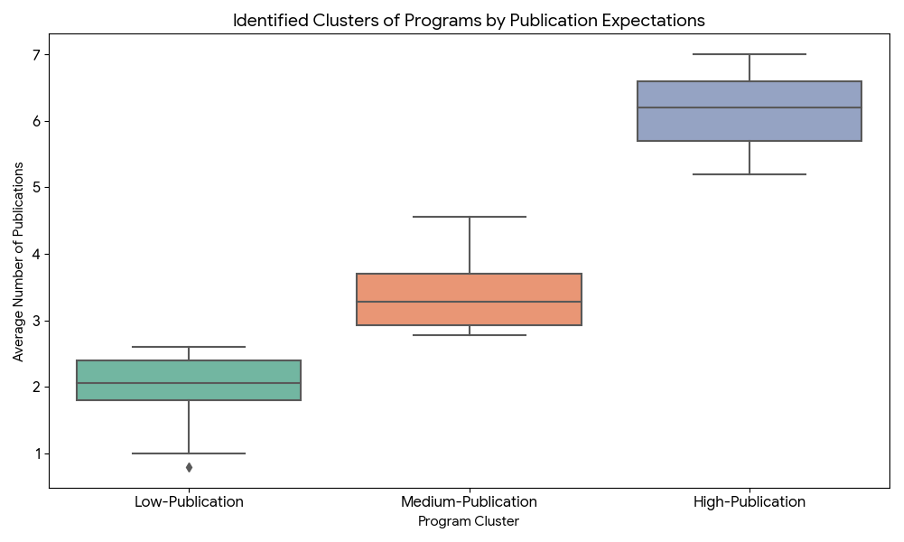
Importantly, higher publication averages do not necessarily correspond to better placement outcomes. Programmes with the strongest placement records often have relatively modest publication averages at graduation (typically between 1 and 3 articles), while some high-publication programmes have less consistent placement outcomes. This may suggest a “prestige–productivity” trade-off: highly ranked programmes may rely more on institutional reputation and professional networks, whereas students from “less prestigious” programmes may compensate by publishing more.
A related pattern emerges in programme ratings. Programmes with higher overall or climate ratings (according to our own data) tend to have lower average publication counts, while some of the highest-output programmes report weaker climate ratings. This suggests that intensive publishing cultures may come with trade-offs in terms of student experience, though causation is difficult to establish.
Finally, publication patterns are strongly field-dependent. Subfields such as logic, philosophy of science, epistemology, and philosophy of language—where shorter, article-based research cycles and co-authorship are more common—are overrepresented in the medium- and high-publication clusters. By contrast, historically oriented or continental subfields tend to have lower publication counts at graduation, reflecting longer research timelines and different norms of scholarly output. At the same time, high-publication programmes also lead in book production at later career stages, indicating that they foster a general culture of high productivity rather than a simple trade-off between books and articles.
Teaching Support versus Labour by Programme
Statistical analysis reveals a distinct split in departmental models between programmes with the highest reported graduate-student teaching loads and programmes where students graduate having led significantly fewer distinct courses. This variation suggests that teaching norms are not uniform but are shaped by vastly different funding models and departmental expectations.
Importantly, higher teaching volume does not correspond to better placement outcomes. Programmes with the strongest records of permanent academic placement often have relatively modest teaching averages at graduation (typically between 2 and 4 unique types). In fact, candidates who secured permanent academic roles reported a slightly lower median number of course types (3.0) than those in contingent roles (4.0).
We found a weak negative correlation (r = -0.07) between the number of courses taught and programme recommendation scores. This indicates that intensive teaching cultures, where students serve as instructors of record for many subjects, may come with trade-offs in student experience and perceived departmental support. Similarly, students in highly-resourced programmes may be shielded from heavy teaching rotations to focus on research, while students in other programmes may carry a much heavier instructional burden to secure funding.
A related pattern emerges in programme ratings and reported support for teaching. We found a weak negative correlation (r = -0.077) between the number of courses taught and the level of formal teaching support (such as mentorship, observations, and pedagogical workshops) provided by the department. Programmes with the highest overall satisfaction and climate ratings tend to be those that offer more formal support but fewer total classes to teach. This suggests that intensive teaching cultures—where students serve as “instructors of record” for many different subjects—may come with trade-offs in terms of student experience and perceived support.
Finally, the data suggest that the quality of preparation outweighs the quantity of the teaching load. Permanent academic hires consistently come from programmes that provide higher average teaching support scores (4.05) compared to those entering non-academic careers (3.71). While having a baseline of 3 to 5 course types at graduation appears to be a standard for the market, the most successful candidates appear to be those from programmes that prioritise structured pedagogical training and mentorship over raw instructional volume.
Methodological Note: In our survey, respondents were asked to select all applicable types of teaching preparation they received from a list of options (e.g., “Instructor of Record”, “Formal Teaching Workshops”, “Guest Lecturing”, and “Faculty Mentorship”). To translate these qualitative selections into a format suitable for statistical analysis, we applied a count-based scoring system as follows: (1) Each distinct type of support selected by a respondent was assigned 1 point. (2) We summed these selections across both undergraduate and graduate-level preparation categories to “Support Score”. (3) The final figures represent the mathematical mean of these individual scores within each career category. By using this method, a higher score indicates that a candidate’s programme provided a more diverse “menu” of formal training and mentorship, although each item selected may vary in terms of depth of training experience.
Conclusion
Taken together, these findings point to several key conclusions regarding the modern academic portfolio:
- The “Threshold” Myth: There is no single “required” number of publications or courses. While a portfolio of 4–5 articles and roughly 5–8 course offerings is typical at the point of a permanent hire, these expectations vary widely. Publication counts at graduation are a stronger predictor of how quickly one gets hired rather than if they get hired.
- Quality vs. Quantity in Teaching: Permanent academic hires often come from programmes that provide more formal support (mentorship and training) but fewer total classes. Graduating with an excessive teaching load (over 10 course types) is more often associated with contingent roles and lower programme satisfaction than with permanent placement.
- No Evidence of Rising Expectations: Both publication and teaching levels at graduation have remained broadly stable over the past decade.
- Statistical Independence: An assumption that research and teaching are in direct tension is not supported by the data. With an R2 of less than 1%, teaching load does not explain the variation in publication output (or vice versa). Candidates accumulate these credentials through distinct pathways—research productivity is likely driven by subfield norms, while teaching loads are likely driven by departmental funding structures.
For current job seekers, the most practical takeaway is this: A modest, balanced record at graduation is typical. The path to a permanent position is not about meeting a fixed, ever-rising threshold, but about navigating a complex landscape where institutional prestige, high-quality pedagogical support, and steady post-PhD scholarly development do the heavy lifting.